decommissioning
wa oil decommissioning
Since WA Oil production commenced in 1967, onshore production wells gathered oil from the field beneath Barrow Island. Processing of the oil occurred on the island before being transported via pipeline to offshore tankers for export. Over nearly six decades of production, WA Oil produced more than 335 million barrels of oil and delivered more than $1 billion in revenue to government.
WA Oil is now a mature asset at its planned end of life. In 2025, the Barrow Island oil field ceased production and moved into the decommissioning phase.
The retirement of WA Oil is set to be one of the largest and most complex petroleum decommissioning projects to be undertaken in Australia. Given the age of the WA Oil infrastructure and historical oil field practices, it is recognised the decommissioning process will present unique challenges. However, with capabilities gained from our successful decommissioning of the Thevenard Island oil facility and support from a team of global experts, we have the expertise and experience needed to carry out the decommissioning safely and manage environmental risks.
Stage 1 of the project will be undertaken between 2025 and 2031. It includes the plugging of ~888 wells and the decommissioning and removal of infrastructure including separator and waterflood stations, ~1500km of pipelines and flowlines, ~570km of roads, terminal tanks, a ~10km loading line, historical accommodation facilities, and power, water and waste facilities. Stage 2 of the project will focus on remediation, landforming and rehabilitation.
The decommissioning of WA Oil marks the end of an important chapter in our history, as we continue to deliver natural gas from our Gorgon and Wheatstone facilities and look to new energy opportunities for a lower carbon future.
thevenard island retirement project
The Chevron-operated Thevenard Island Joint Venture oil facility has been safely decommissioned after 25 years of production.
First explored in the 1960s, the facility commenced oil production in 1989, with approximately 150 million barrels of oil produced during its 25-year life until production ceased in 2014.
The decommissioning project was logistically complex given the remote location of the island. Onshore decommissioning involved the plugging of 11 production wells, 3 water disposal wells, 1 exploration well and the safe dismantling and removal of three 150,000-barrel oil storage tanks, production tanks, separator vessels, flowlines, process infrastructure and accommodation facilities and utilities, as well as the controlled toppling of the 38-metre communications tower. In total, the project resulted in the removal of more than 5,000 tonnes of scrap metal from the island for recycling.
The offshore decommissioning involved the plugging of 23 wells and removal of nine platforms.
Together with our local business partners, we’re now undertaking important rehabilitation works on Thevenard Island to restore the environment and protect its unique biodiversity. The rehabilitation approach was underpinned by more than a decade of research and studies to gain a comprehensive understanding of coastal dynamics and landform stability, climate, soil properties and methods for re-establishing flora and vegetation.
Revegetation activities began with sourcing seeds and cuttings of 14 target species indigenous to Thevenard Island to grow and supply the native seedlings for planting. We worked with local partners NTC Contracting, disability support and employment provider Workpower, and the Onslow Indigenous Sea Rangers to plant more than 160,000 seedlings - supporting local jobs and businesses in the process.
Monitoring of rehabilitation will be carried out over the next few years. Our goal is to restore the site to a condition similar to and compatible with the adjacent conservation nature reserve environment, and the island’s future tourism activities.
The decommissioning project marks a significant milestone for WA’s emerging decommissioning industry, delivering positive outcomes for the environment and the local community.
-
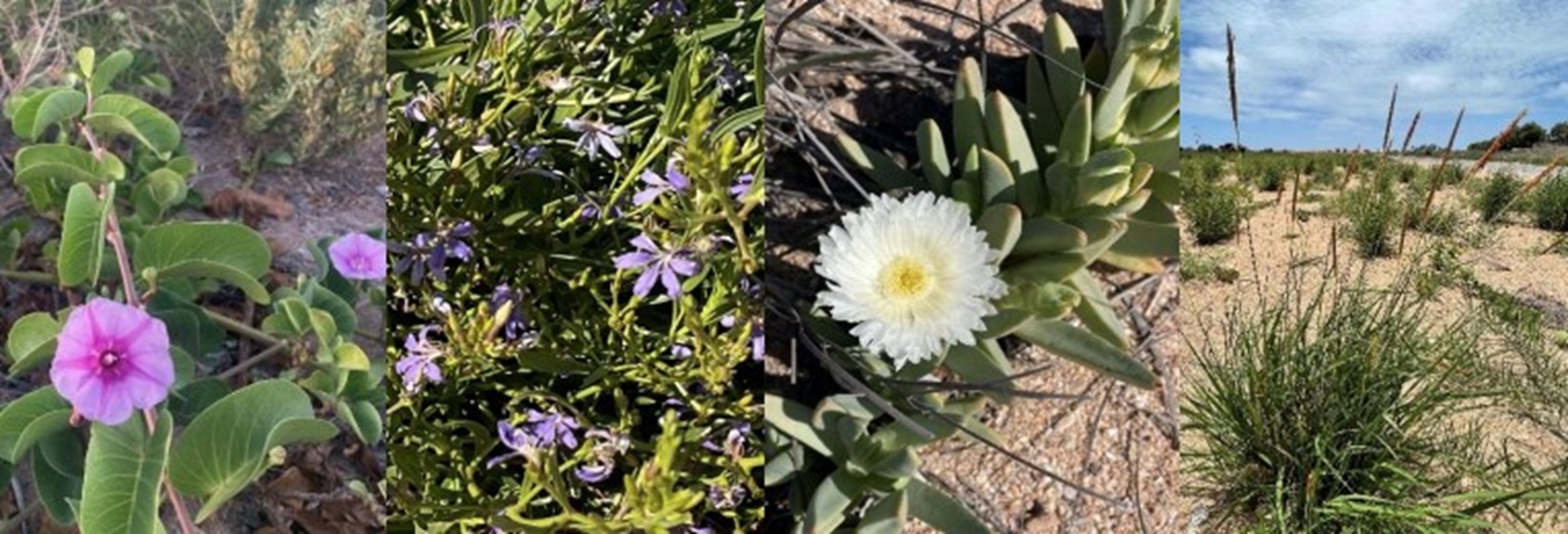
Reinstated native vegetation is flowering within the Chevron lease area (left to right Ipomoea pes-caprae, Scaevola cunninghamii, Carpobrotus sp. Thevenard Island, Eulalia aurea)
-
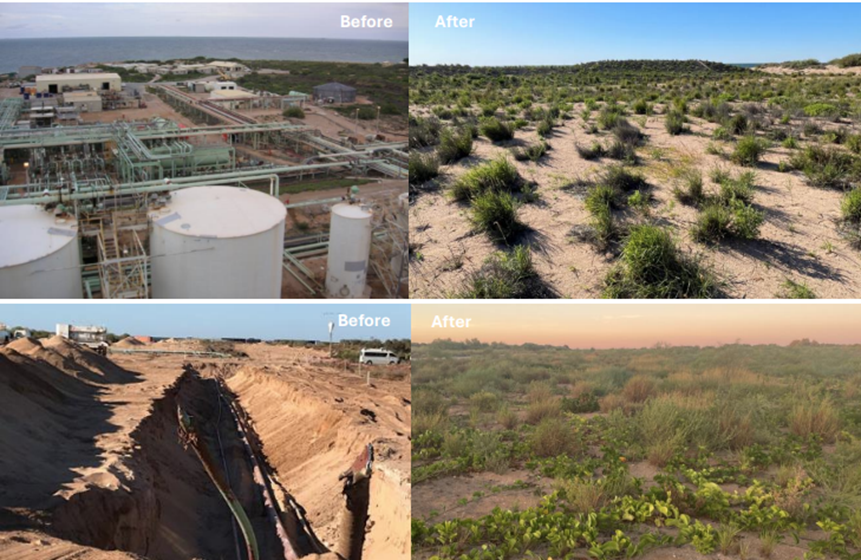
Examples of complete restoration works - Thevenard Island processing plant in 2020 before decommissioning (top left) and in 2024 after rehabilitation (top right), looking east towards the reconstructed dune; Southern pipeline corridor in 2020 before decommissioning (bottom left) and in 2025 after rehabilitation (bottom right).